That growing interest comes down to one practical issue: capacity and length are only part of the job.
A trailer may have the right rating, the right deck space, and the right basic configuration for the load. But the next question is whether the full combination can turn, enter the site, move through the route, and position the freight where it needs to go.
That is where steerability enters the conversation.
A steerable axle trailer helps control the rear of the trailer through tight turns, jobsite entrances, small-town routes, and other spaces where a fixed rear axle setup may struggle. It's not the right fit for every buyer. But for the right buyer, it can be the difference between having enough trailer on paper and having the right trailer for the job.
This guide is built for buyers who are starting to ask whether steerability belongs in their next trailer spec.
This guide will help you understand:
- Where steerable axle trailers make sense
- How the main systems differ
- Which specs matter before you quote
- What costs should be considered
- And which assumptions can lead to the wrong purchase
The goal is simple: help you ask better questions before you spend the money.

1. Why Buyers Start Looking at Steerable Axle Trailers
Most buyers do not start by asking for a steerable axle trailer. They start with a problem.
The load is longer than usual. The route has tighter turns. The jobsite has limited room. The customer has a specific unload location. The manufacturer requires a steerable setup. Or the buyer is trying to win heavier, bigger, or more specialized work than their current trailer can handle.
The issue is often not just whether the trailer can carry the load. The issue is whether the trailer can get the load where it needs to go.
That is an important difference.
A standard trailer may have the right capacity and still be wrong for the job if it cannot handle the access conditions. A standard extendable may have the right length and still create problems if the rear of the trailer cannot be managed through the route or site.
Buyers commonly start looking at steerability when they are dealing with:
- Tight turns
- Small-town routes
- Narrow entrances
- Restricted jobsite access
- Longer truck and trailer combinations
- Larger or heavier loads
- Building moves
- Offsite construction
- Large manufactured components
- Data center-related hauling
- Manufacturer or project-owner requirements
- Routes or jobs they cannot confidently take with a standard trailer
That last point really matters. Steerability is not only about getting through a turn more cleanly. It can also affect the work a buyer is able to accept. If the trailer can maneuver roads, turns, and jobsites that a standard setup cannot handle, or do it with less routing friction, the buyer may be able to pick up loads they would otherwise have to pass on.
In some cases, the buyer is trying to solve a known problem. In others, they are trying to avoid being limited later.
These factors need to be considered because trailer buying should not only be based on today’s load. If the work is getting bigger, heavier, or more specialized, the trailer should be spec’d with that direction in mind.
CASE IN POINT: BUILDING MOVES
Building moves are a clear example. Manufactured building units are often produced at one facility and relocated to a project site in another state, sometimes dozens of units for a single project.
Moving that volume efficiently depends on equipment that can get in and out of the sites involved. If the trailer cannot maneuver the roads, turns, entrances, and unload areas required for the job, the buyer may not be able to take the work in the first place. That is exactly the kind of situation steerability is built for.
The right question is not, “Do I need the most expensive configuration?”
The better question is, “What work do I need this trailer to help me take?”
If steerability opens access to jobs, routes, or sites that a standard trailer cannot handle, it should be part of the quote conversation early.

2. What Steerability Changes in the Real World
Steerability is easy to reduce to one phrase: better turning. That is true, but incomplete. The real value is rear-end control.
When a truck and trailer combination gets long, the back of the trailer becomes harder to manage. The tractor may clear the corner, but the rear axles and the load still need to make it through. That becomes especially important when the combination is stretched out, running through a small town, entering a construction site, or moving into a tight unload area.
Depending on the setup, a truck and trailer combination can reach 80 to 90 feet long. At that length, the rear of the trailer is often where the move becomes difficult.
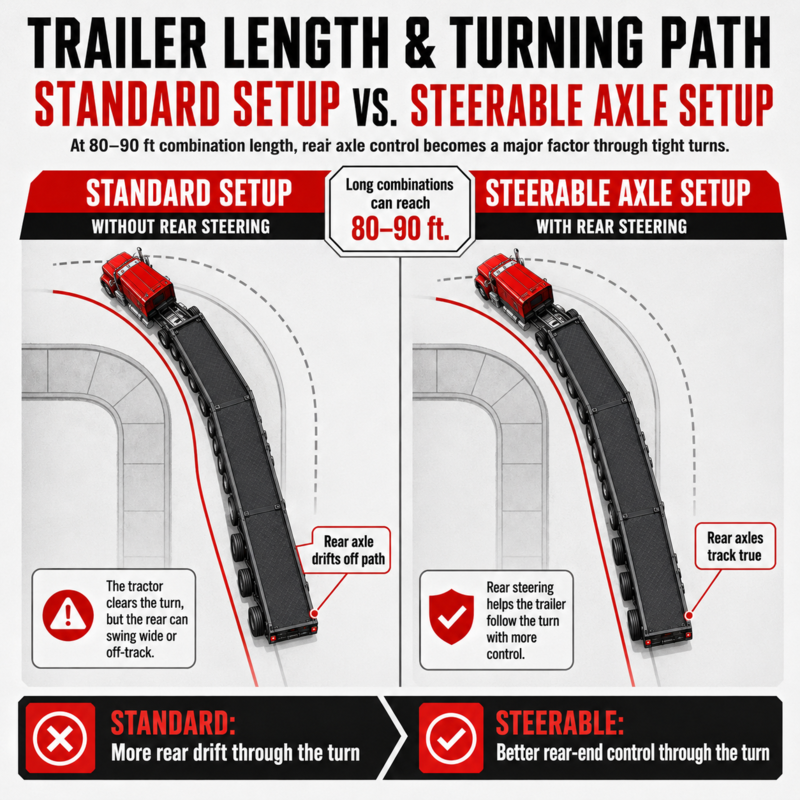
A steerable axle trailer gives the operator a way to help guide that rear section through the turn.
With a command-steer system, the rear axles can be controlled by the driver or by a pilot car operator using a wireless remote. In many situations, the pilot car operator may have the better view. They are closer to the rear of the load, closer to the corner, and better positioned to see what the back of the trailer is doing.
That visibility matters.
The driver can operate the steering, but from the cab, it may be harder to see the rear axle path and nearby obstacles. A pilot car operator behind the load may be able to make more informed steering adjustments because they can see the trailer’s rear movement more clearly.
Steerability helps operators:
- Navigate tight jobsite entrances
- Move through difficult turns
- Handle longer combinations with more control
- Position the trailer more effectively at the unload point
- Meet job requirements that call for a steerable trailer
- Pursue work that may not be practical with a standard setup
This does not mean steerability eliminates planning. It does not replace route review, permitting, escort coordination, or driver judgment. It simply gives the operation another tool when the rear of the trailer needs to be actively managed.
For some jobs, that tool is optional. For others, it is what makes the job possible.
3. Understanding the Main Steerable Axle Systems
Buyers do not need to become engineers to understand steerable axle trailers. But they do need to understand one basic question: Who controls the steering?
That is the clearest way to separate the main options. Some steerable systems are actively controlled by a person. Others are designed to automatically follow the movement of the truck and trailer.
Option 1: Command Steering (Remote Steering)
With command steering, the rear axles are actively controlled by the driver or pilot car operator. XL’s turntable-style steering is one example of this approach.
In this setup, the operator uses a wireless remote to steer the rear axles left or right as the trailer moves through a turn, driveway, route constraint, or jobsite entrance. XL describes this as a four-function wireless remote.
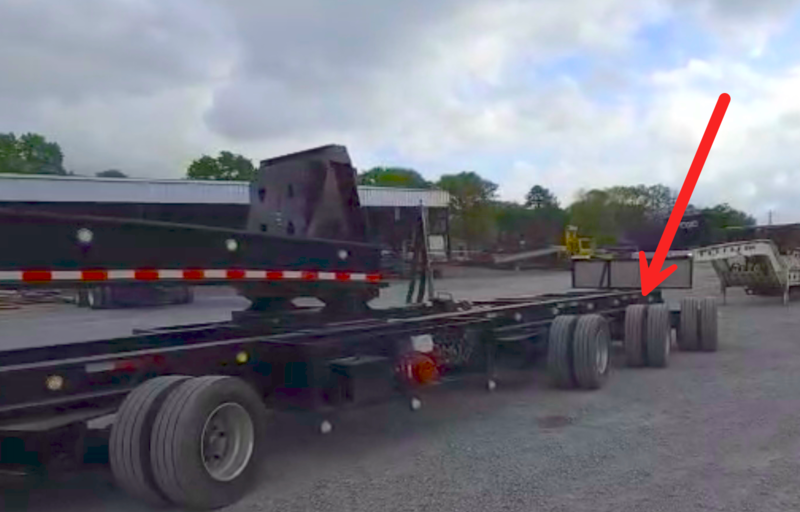
This is the system many buyers picture when they hear “steerable axle trailer.” Someone is watching the rear of the trailer and actively helping guide the axle movement.
In many cases, the pilot car operator may be the better person to control the steering because they are behind the trailer and closer to the load. That position can give them a better view of the rear axles, the corner, and the space around the trailer.
The most common misconception is that command-steer trailers are hard to run. They are specialized, and they require planning, but the steering control itself can be straightforward. The bigger issue is whether the operator has visibility, communication, and a clear plan for the move.
Option 2: Auto Steer
Auto steer works differently. With TRIDEC Auto Steer, the system steers off the kingpin and automatically follows the truck and trailer through the turn. Instead of having a driver or pilot car operator control the rear axles with a remote, the system follows the movement of the combination.
The practical difference is control.
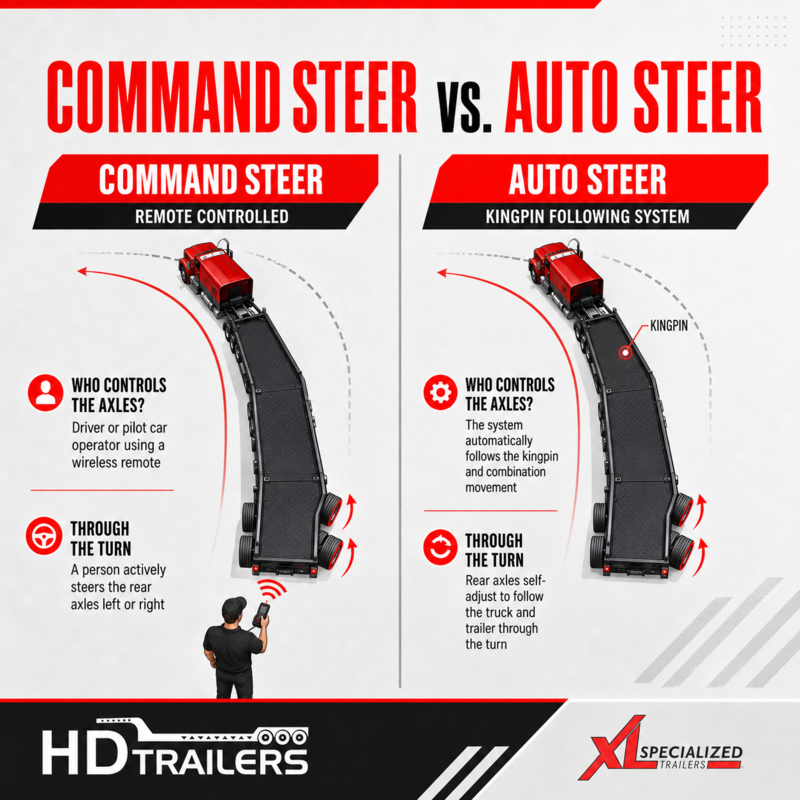
Command steering is actively operated by a person. Auto steer follows the truck and trailer automatically.
Neither option is automatically better in every situation. The right choice depends on the trailer, the load, the route, the site, and how the buyer intends to operate.
Before comparing quotes, buyers should ask:
- What type of steerable system is included?
- Is it command steer or auto steer?
- If it is command steer, who will operate the steering?
- If it is auto steer, how does the system follow the combination through the turn?
- What does the driver or pilot car operator need to do?
- How much familiarization will the team need?
- Does this system fit the routes and jobsites the trailer will be used for?
Steerability should not be treated as one generic feature. The system type affects how the trailer operates in the field.
4. Specs That Matter Before You Quote
Axle count, capacity, deck height, trailer length, flip axle compatibility, and power requirements all affect whether the trailer fits the jobs you intend on bidding on. Treating them separately can lead to the wrong build.
➤ Axle Count and Capacity
Axle count starts with weight.
If a buyer is choosing between tandem, tridem, or a larger multi-axle setup, the first question is how much weight the trailer needs to haul. The next question is whether future loads may get heavier or bigger.
That second question is where buyers often get into trouble.
A trailer built only for today’s work may not fit tomorrow’s opportunities. If the buyer expects to pursue larger or heavier loads, that should be discussed before the quote is finalized.
As a general planning reference, many permitted-load conversations start around 20,000 pounds per axle. That does not replace permit review, and it does not apply the same way in every state, route, or configuration. But it helps explain why axle count becomes part of the capacity conversation so quickly. More weight usually means the buyer needs to think harder about axle count, axle spacing, route limits, and the permit environment where the trailer will run.
Capacity classes such as 55-ton, 60-ton, 65-ton, and 70-ton should be tied to the buyer’s load profile. For heavier specialized work, the conversation can go beyond those classes. XL Specialized offers larger multi-axle configurations, including setups that can go up to 13 axles and 90-ton ratings for the heaviest loads.
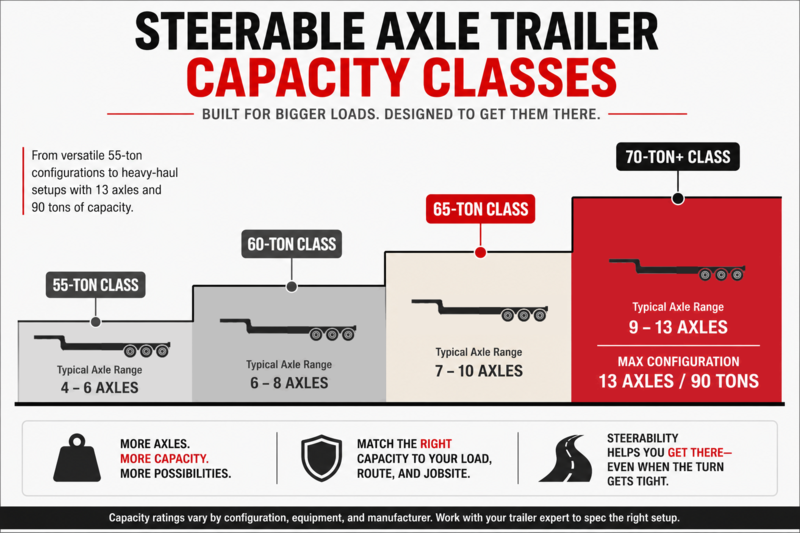
The right choice depends on the loads being hauled, the jobs being pursued, and the amount of headroom the buyer wants built into the trailer.
➤ Deck Height and Trailer Length
Deck height still matters.
If the load is tall, the loaded deck height can affect route options and clearance. A few inches can matter when the freight is oversized or height-sensitive.
Trailer length matters too, but length should be evaluated with maneuverability. An extendable trailer may provide enough deck length, but once extended, the combination may become harder to route or position. That is where steerability can become important.
Buyers should explain not only how long the load is, but where the trailer will be operating when extended.
➤ Flip Axle Compatibility and Future Flexibility
Future flexibility should be part of the original spec conversation.
A buyer may not need added axle flexibility today, but if future work points toward heavier or more complex loads, it may be easier to plan for that during the original build than to work around the limitation later.
This is one of the places where saving money upfront can limit the trailer’s usefulness later.
➤ Wet Line or Pony Motor
Power requirements should be confirmed early.
If the truck has a wet line, that may support the trailer’s hydraulic needs. If it does not, the buyer may need a self-contained power unit, often called a pony motor.
XL uses a 13HP Honda pony motor as a standard self-contained option when the truck does not have a wet line.
This detail affects cost, setup, operation, and compatibility. It should not wait until the end of the quote process.
➤ Route and Site Conditions
The dealer needs more than load weight.
For a steerable trailer quote, buyers should be ready to describe:
• Tight turns
• Route restrictions
• Small-town travel
• Narrow driveways
• Site access limitations
• Terrain
• Unload location
• Pilot car expectations
• Manufacturer or project requirements
The more clearly the buyer describes the work, the better the trailer recommendation will be.
5. Cost, Payback, and What Buyers Should Not Assume
Steerability adds real cost. Based on XL input, the upcharge is about $25,000 per steerable axle. Depending on the configuration, that can become a significant increase over a standard setup.
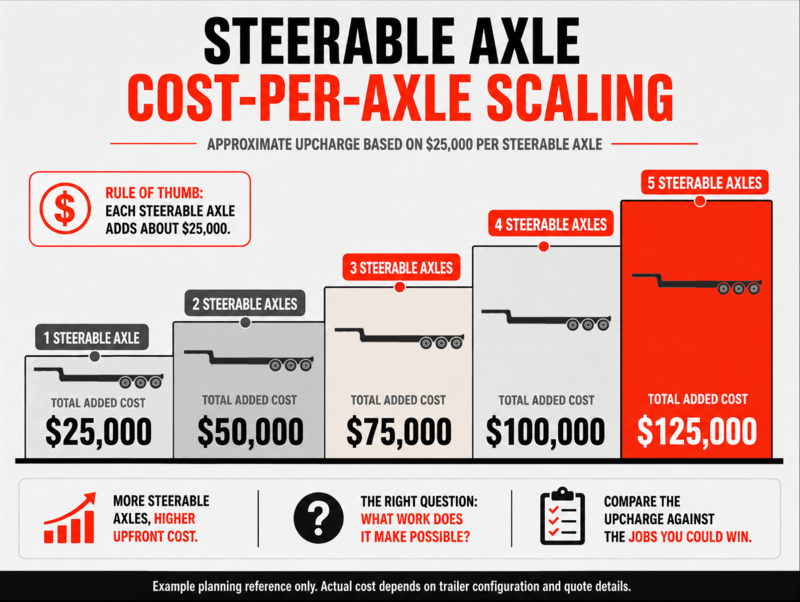
Buyers should take that seriously. But they should also avoid building the whole decision around savings claims that are difficult to prove.
Tire life may vary. Fuel savings may vary. Resale value may vary. Those numbers depend on load type, road conditions, miles, maintenance, tire setup, driver behavior, route profile, and market demand.
They should not be treated as guaranteed payback.
That does not mean steerability lacks financial value. It means buyers should measure the value differently.
The stronger question is: What work does steerability make possible?
A steerable axle trailer may help a buyer:
- Accept jobs that specifically require steerability
- Access jobsites a standard trailer cannot reach
- Handle longer combinations through tighter routes
- Move into larger or heavier load categories
- Support specialized project work
- Avoid turning down work because of trailer limitations
- Bid stronger on jobs that call for it
Because steerable-capable equipment is still relatively uncommon, buyers who have it are often in a position to bid these jobs at a stronger rate, not just win access to the work, but win it on better terms.
That is the real cost conversation.
If the trailer helps secure work that would otherwise be unavailable, the added cost should be compared against the opportunity, not only against the base trailer price.
Buyers should also remember that steerability does not automatically change permit requirements. Weight, dimensions, route, state rules, pilot car requirements, and combination length still need to be reviewed. Steerability can help with maneuverability, but it does not remove the need for compliance planning.
Before treating a steerable axle trailer as too expensive, buyers should ask what the cheaper trailer cannot do. That answer may matter more than the first price difference.
6. Common Buyer Mistakes
The wrong trailer usually looks reasonable during the quote process. The problems show up later, when the buyer tries to use it.
Here are eight common mistakes to avoid: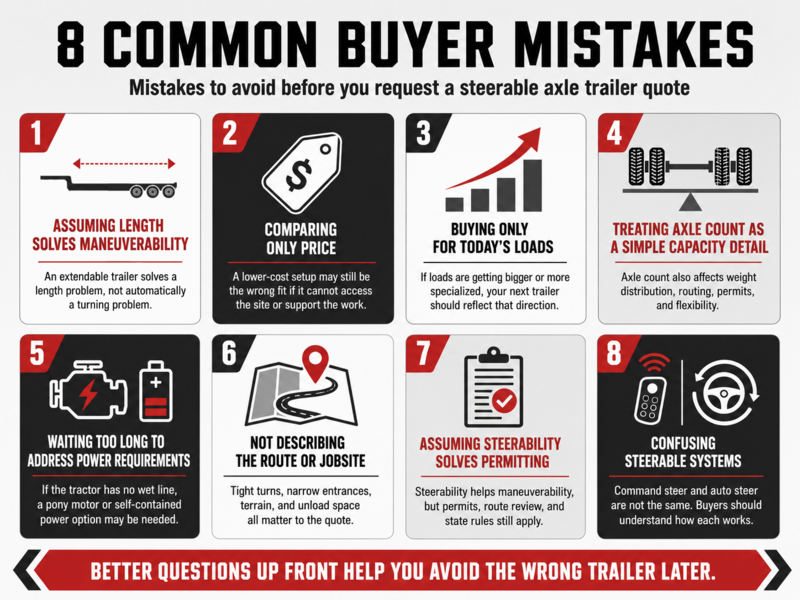
Mistake #1 ➤ Assuming Length Solves Maneuverability
An extendable trailer solves a length problem. It does not automatically solve a turning problem.
If the route or site is tight, buyers should evaluate whether the rear of the trailer needs steerability once the trailer is stretched out.
Mistake #2 ➤ Comparing Only Price
A standard configuration may cost less, but that does not make it the better fit.
If the trailer cannot access the site, meet the job requirement, or support future work, the lower upfront price may create limits the buyer did not plan for.
Mistake #3 ➤ Buying Only for Today’s Loads
Today’s work may not reflect where the buyer is headed.
If loads are getting bigger, heavier, or more specialized, the trailer should be spec’d with future opportunity in mind. Data center-related hauling is a good example. As AI infrastructure projects continue to grow, buyers may see more demand for large manufactured components, power equipment, cooling systems, and other specialized freight tied to those builds.
A trailer spec that fits today’s regular loads may not be enough for the project work a buyer wants to pursue over the next few years.
Mistake #4 ➤ Treating Axle Count as a Simple Capacity Detail
Axle count affects more than how much the trailer can carry.
It connects to weight distribution, routing, permit conversations, combination length, and flexibility. It should be discussed as part of the full trailer configuration.
Mistake #5 ➤ Waiting Too Long to Address Power Requirements
If the tractor does not have a wet line, the trailer may need a pony motor or self-contained power option.
That affects the quote and the way the trailer will operate. Confirm it early.
Mistake #6 ➤ Not Describing the Route or Jobsite
A dealer cannot recommend the right trailer from load weight alone.
If the trailer will face tight turns, narrow entrances, uneven ground, small towns, or limited unload space, those details need to be part of the conversation.
Mistake #7 ➤ Assuming Steerability Solves Permitting
Steerability helps with maneuverability. It does not erase compliance requirements.
Permits, route review, pilot cars, and state-specific rules still need to be handled through the proper channels.
Mistake #8 ➤ Confusing Steerable Systems
Command steer and auto steer are not the same.
Buyers should understand how the system works, who controls it, and whether it fits their operating environment.
7. Questions to Ask Before You Request a Quote
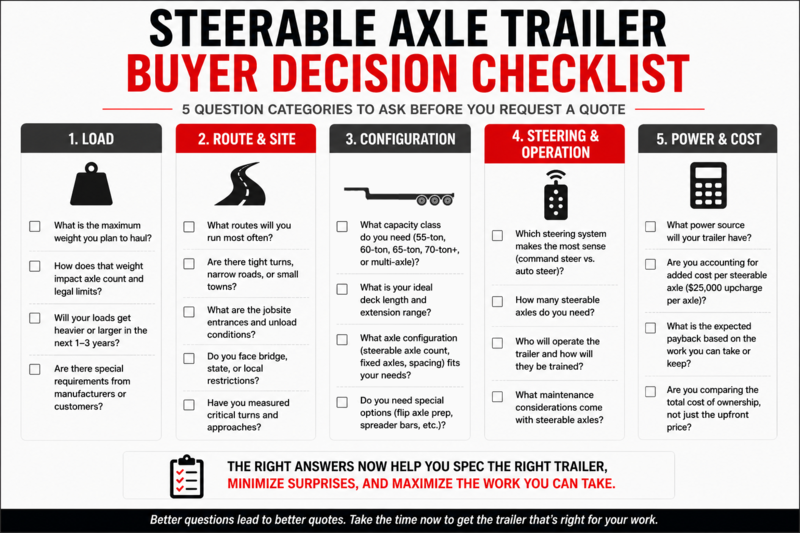
A better quote starts with better information. Before requesting pricing on a steerable axle trailer, answer these questions:
Load
- What are you hauling most often?
- What is the heaviest load you expect to haul?
- What is the longest load you expect to haul?
- Are loads getting larger, heavier, or more specialized?
- Are you trying to pursue work your current trailer cannot handle?
Route and Site
- Will the route include tight turns, small towns, narrow roads, or restricted access?
- Will the trailer operate extended in difficult areas?
- How tight is the site entrance?
- Is the unload area open or constrained?
- Is the ground paved, soft, uneven, or sloped?
- Does the manufacturer or project owner require steerability?
Trailer Configuration
- Do you need tandem, tridem, or a larger multi-axle setup?
- What capacity class fits the work?
- What deck height does the load require?
- Do you need an extendable configuration?
- Should flip axle compatibility or future scalability be built in?
- Are you buying for current work only, or for the next several years?
Steering and Operation
- Is the trailer command steer or auto steer?
- Who will operate the steering?
- Will a pilot car operator control the rear axles?
- What familiarization will the team need?
- What service and parts support is available?
Power and Cost
- Does your tractor have a wet line? If not, does the quote include a pony motor or self-contained power unit?
- How many steerable axles are included?
- What is the added cost per steerable axle?
- What work would you miss if you bought the lower-cost configuration?
Make the Right Decision Before You Quote
A steerable axle trailer is not for every buyer, but it can be the right choice when standard trailer specs no longer match the work.
The key is knowing the difference before you quote. If the job involves tight access, longer combinations, heavier freight, project requirements, or routes that limit what a standard setup can handle, steerability deserves a serious look.
The best trailer decision is not just about capacity or price. It is about whether the trailer can help you take the work, move the load, reach the site, and support the jobs your business is trying to win next.
